Skip to content
The Book · 10 chapters · 256 pages

Order The Small-Business Money Game today.

A clear-eyed guide to the eight predictable breakpoints every growing company hits — and the four numbers that tell you which one you're standing in front of. Rob Aquino wrote this for the operators, not the accountants.

Order wherever books are sold
2026First edition
256Pages
10Chapters
6Companion tools
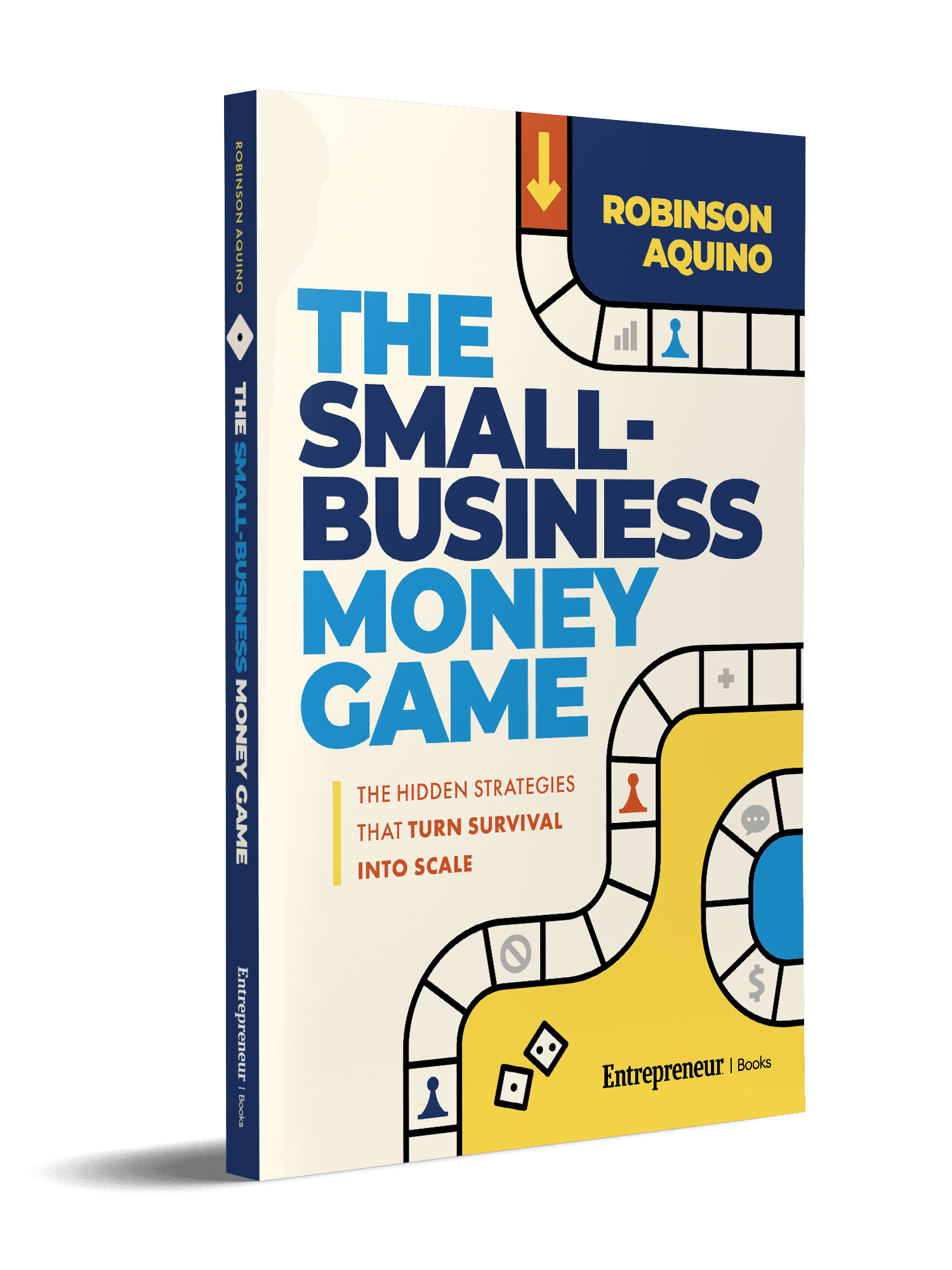
The Small-Business Money Game — book cover by Robinson Aquino
#1 Amazon Best Seller
Barnes & Noble Best Seller
Published by Entrepreneur Books
Distributed by Simon & Schuster
Business owners do not fail because they lack effort. They struggle when the systems, pricing and financial visibility around them are not strong enough to support the business they want to build.
Robinson Aquino · from the launch announcement
Table of Contents

Ten chapters. One straight line through the fog.

The book moves from first principles (what 'money' actually means in a small business) to the operator's toolkit: the four numbers, the eight breakpoints, and the decision docs that hold it all together.

00
The Backbone of the American Economy Has a Name—It's You
01
The Theory of Games
The Critical Lessons the Game Teaches Us All
02
Starting from “Go”
Understanding Your Starting Point and Gathering Your Players
03
The Moneyball Strategy
How Data-Driven Decisions Deliver Successful Outcomes
04
Why Small Businesses Are Designed to Fail
Understanding the Breakpoints That Stall Growth and Bring Companies Down
05
Pricing Is an Art—Accounting Is a Science
A Deep Dive into Your Revenue, Pricing, and Profits
06
Starting Smart, Starting Small
Planning to Succeed with Your Startup
07
Turnaround and Transformation
What Breaking Down Can Teach You About Scaling Up
08
Strategic Scaling
How Small Businesses Achieve Transformational Growth
09
Measuring Wealth
Why the Balance Sheet Reigns Supreme
10
Choose Wisely
Crafting Your Roadmap and Support System
From Ch. 2 — The Breakpoint Ladder

Eight stages. Same walls. Every time.

The numbers change by industry. The walls don't. Every stage has its own constraint, its own hire, its own decision — and a predictable moment where the old playbook stops working.

01
$0–100K
Proof of Concept
Owner-does-everything. The question is “does anyone want this?” — not “how do I scale?”
02
$100K–$250K
Decision to Build a Company
First true fork in the road. Decide whether to remain self-employed or commit to building something bigger — perhaps recruiting a Technician or two.
03
$250K–$500K
The Hiring Challenge
Personal capacity hit. Growth depends on others. Learning to hire, delegate, trust — the painful leap from Technician to Manager.
04
$500K–$1M
The Operational Ceiling
Hustle stops working. Systems, processes, and structure become the only way forward. Standards emerge for hiring, pricing, and selling.
05
$1M–$2M
The Goals and the Operator
Planning replaces guessing. Forecasts, budgets, measurable goals. Many founders realize they lack the skills to keep growing — consistency becomes the new currency.
06
$2M–$5M
The Leadership Team
The company needs leaders, not just loyal staff. Departments take shape. Culture shifts from familiar to professional. The one Rob has seen kill the most 'successful' small businesses.
07
$5M–$10M
The Self-Managing Company
The business must begin to operate beyond your daily involvement. The breakpoint where founders either become true CEOs — or growth stalls.
08
$10M–$25M
The Road to Middle Market
Few make it here. Real complexity: ballooning OPEX, mounting capital requirements, the tightrope of growth, liquidity, and control. Every decision is strategic.

Robinson Aquino, author of The Small-Business Money Game
The Author

Rob Aquino has spent 12 years sitting across from founders at every stage of the ladder.

CEO of JBS Corp, Rob works with small-business owners across the breakpoint ladder — from $250K through $25M — as a fractional CFO and strategic advisor. He's seen the four numbers move thousands of different ways and has written down the patterns in one place for the first time.

He lives outside Boston with his wife, Carleigh, and their three children. He keeps his client list short and takes new advisory work through the Work With Rob page.

His speaking, board work, and podcast appearances live on his personal site, robinsonaquino.com.

Read the full bio →
Read Before You Buy

The first thirty pages, free.

If the framing lands, keep going — the other nine chapters are where the leverage is.

From the Introduction
“Most owners can recite their revenue. A few know their margin. Almost none can tell you, on the spot, what their labor is worth as an asset.”

This book is about the four numbers that answer every other question — and the eight stages where they shift. If you can read those numbers, you can see the next wall before you hit it.

Rob Aquinop. 4